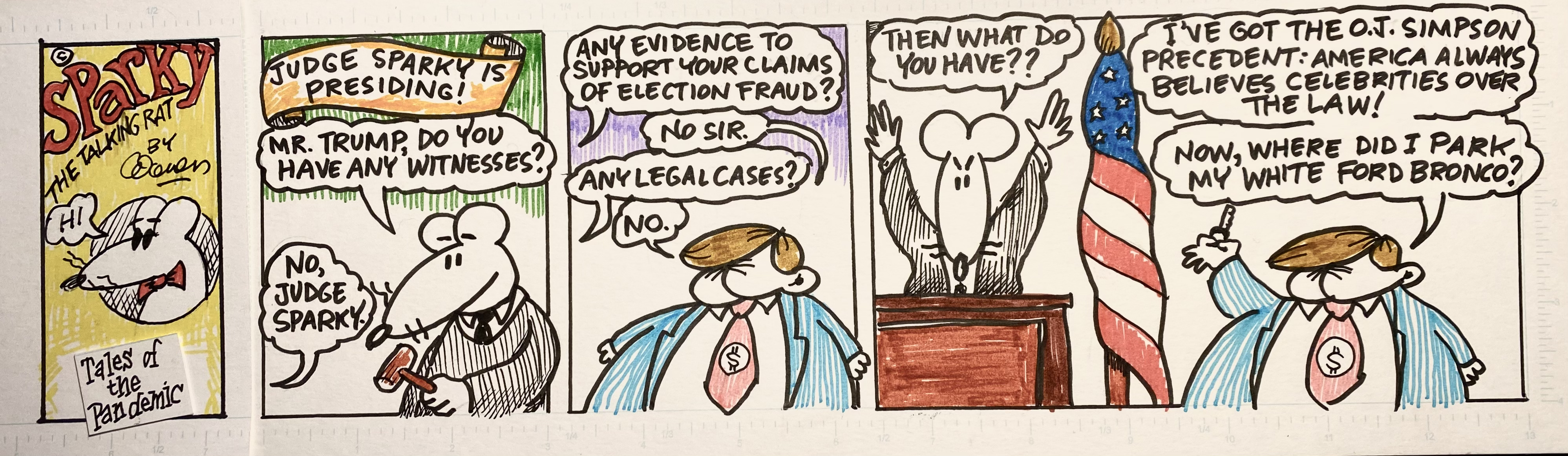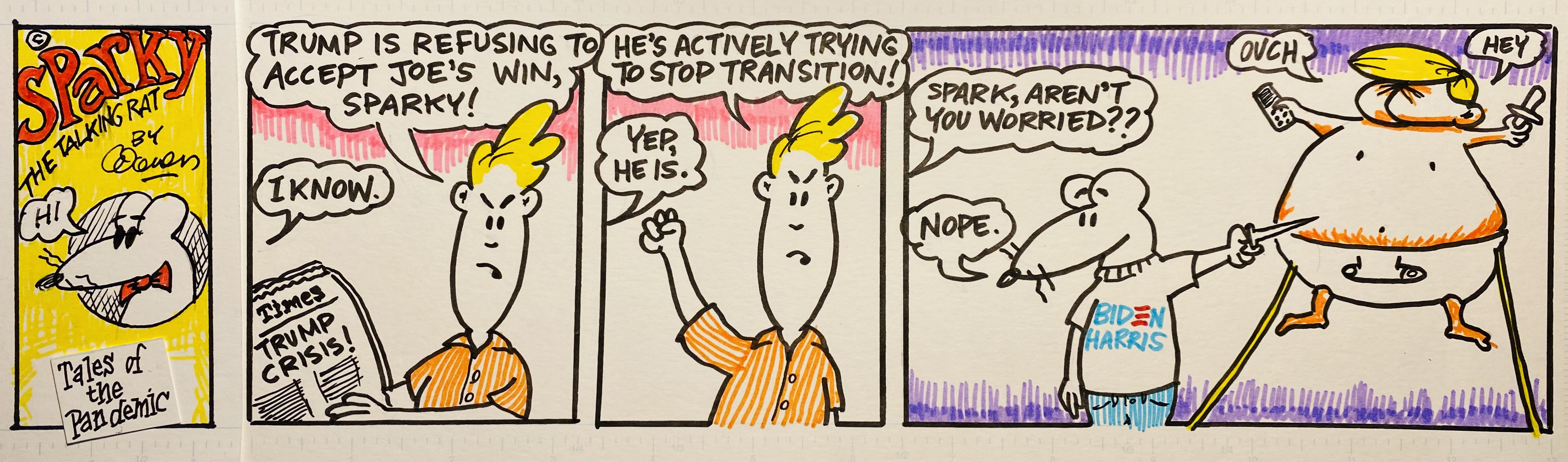
My latest in the Sun: pandemic politics for poltroons

Donald Trump: you’re fired.

And Joe Biden didn’t fire you. The coronavirus did.

By voting day, Nov. 3, nearly 60% of Americans disapproved — or strongly disapproved — of Trump’s handling of the pandemic that is killing about a thousand of them every single day.

Ask any political consultant: when that many voters disapprove of what you are doing, you’re toast.

It wasn’t always that way for Trump. Way back at the start of the pandemic, Americans supported his leadership. At the end of March, in fact, when it felt like the world just might be ending, Trump’s performance was approved of by a narrow majority of Americans, said polling aggregator FiveThirtyEight.

That all changed on or about the first week of April. That was the week that U.S. COVID-19 deaths surged past the symbolic number of 10,000. After that, Trump was never again seen as handling the pandemic well. From July onward, the U.S. President’s performance rating remained constant: 60% of Americans were unhappy or very unhappy with him.

In those circumstances, Joe Biden essentially needed to maintain a pulse and smile a lot, which is what he did. His campaign, meanwhile, devoted itself to getting out the Democratic vote early — a process Trump mocked and attacked. It would prove to be a fatal mistake. Biden won mainly because of the support of those who voted early.

So, the pandemic can certainly end political careers, as it did for one Donald J. Trump. But elsewhere — in Canada, for instance — what effect does COVID-19 have on political outcomes?

Well, up here, there has not been a single incumbent government that has been defeated during the pandemic. Not one.

The minority NDP government in British Columbia was transformed into a majority, mid-pandemic. Same thing happened in New Brunswick: the minority Progressive Conservative government was elevated to a majority. In Saskatchewan, the Saskatchewan Party was re-elected, too — to its fourth consecutive majority government.

Federally, there hasn’t been a pandemic election, but Prime Minister Justin Trudeau was recently clearly tempted to engineer his own defeat.

In October, Trudeau refused to go along with Opposition demands to create a Parliamentary committee tasked with probing the propriety of government spending. Trudeau sent out his House Leader to state that the Liberal government considered the vote on the committee to be a confidence matter — meaning there would be an election if the government fell

It was absurd, it was ridiculous, it was unnecessary. It was also uniquely Canadian, too: only here — with our preoccupation with peace, order and good government — would a federal election be held over creating a committee!

If masked-up Canadians had trooped to the polls, would Trudeau have won? Yes. Ipsos pegged Trudeau’s support at six points above the Erin O’Toole’s Conservatives around the time of the committee contretemps. Abacus Data said the Liberal lead was as much as eight points.

Angus Reid found a smaller Grit advantage over the Tories — but two-thirds of Canadians, roughly, said that Trudeau’s government had handled the pandemic well. That figure has remained more or less constant since March, Angus Reid noted.

So what does it all mean? The polls don’t tell us that, exactly. But everyone accepts that the pandemic has massively disrupted our lives — politically, economically, socially, culturally. It is perhaps the biggest change most of us have ever faced as citizens.

That’s why incumbent governments are getting re-elected. Unless politicians have completely botched their response to the pandemic, voters are opting for the devils they know over the ones they don’t. They’ve quite enough disruption in their lives, thank you very much. They don’t want more.

Donald Trump is the exception. He made such a mess of his pandemic response, they couldn’t forgive him.

So they fired him.

Victory!

(CNN) The General Services Administration has informed President-elect Joe Biden that the Trump administration is ready to begin the formal transition process, according to a letter from Administrator Emily Murphy sent Monday afternoon and obtained by CNN.

The letter is the first step the administration has taken to acknowledge President Donald Trump’s defeat, more than two weeks after Biden was declared the winner in the election.

Murphy said she had not been pressured by the White House to delay the formal transition and did not make a decision “out of fear or favoritism.”

“Please know that I came to my decision independently, based on the law and available facts,” Murphy wrote. “I was never directly or indirectly pressured by any Executive Branch official — including those who work at the White House or GSA — with regard to the substance or timing of my decision. To be clear, I did not receive any direction to delay my determination.”


Raw power

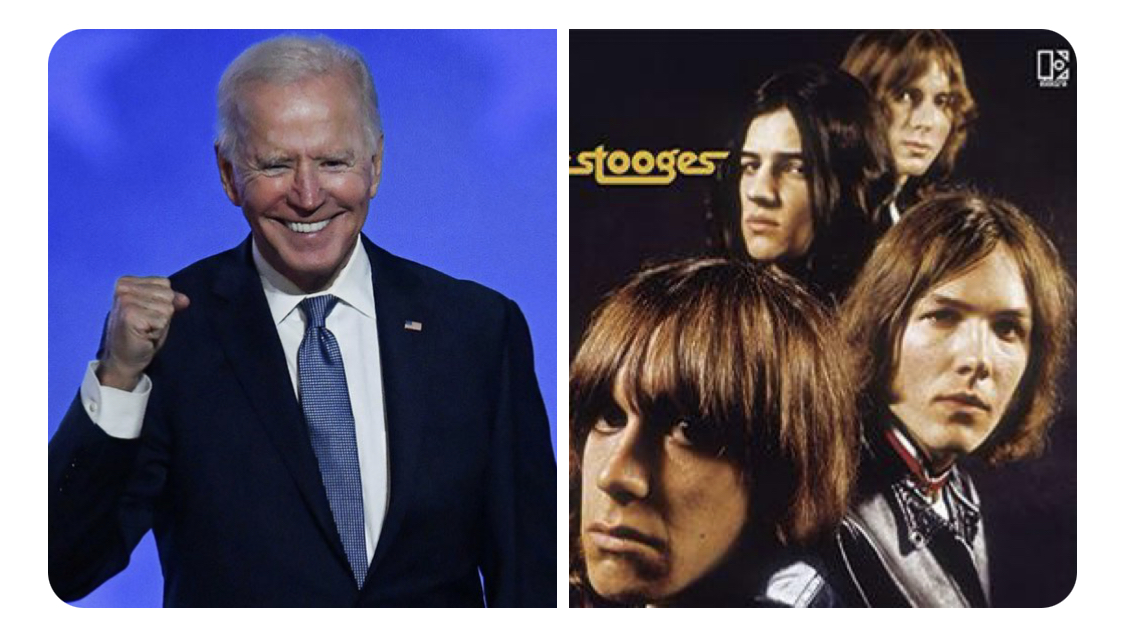
The certification of Joe Biden’s massive win is the best thing to come out of Michigan since the Iggy and the Stooges’ first album!


The death of our king

It was January 1967, just after New Year’s, and my Dad came home from Parkland Memorial Hospital in Dallas, where he worked as a doctor. He was preoccupied.

Jack Ruby, the man who had killed Lee Harvey Oswald – and Oswald being the man who had killed John F. Kennedy – was dying of cancer at the hospital, my Dad told us. The Warren Commission would later conclude that Ruby was a nobody. But, for a man considered so unremarkable by the powers-that-be, he had attracted a remarkable amount of attention from the powerful.

“There are FBI agents all over the hospital,” my father told us, a bit bewildered. “Dozens of them. None of us can get anywhere near the floor where he is. They don’t want anyone talking to him, or interacting with him.”

To us – Irish Catholic Canadians living in Dallas – Ruby’s fate was of more than passing interest. To us, Kennedy had been our hope, our liberator, our Obama before there was Obama. He was the first Irish Catholic to become President, and – from the perspective of my Irish Catholic family, then and now – he was murdered on November 22, 1963 principally because of that.

My maternal grandmother was succinct about it all, as she was about everything. “We are Irish and Catholic, and we were lower than dirt, to them,” she said. “They killed him because they couldn’t get over the fact an Irish Catholic had become president.”

“They,” of course, were the white, Protestant compact that had ruled the United States of America since its beginnings. And, if you ever doubted the extent of their power, you should have lived with our family in Dallas, Texas in the Sixties. Back then, Dallas was the epicenter of racism and injustice on the continent. It was a furnace of hate.

We didn’t have much money, because my Dad was starting out, and my Mom was at home raising my two brothers and me. We lived next door to a Mexican-American family, and their son David was one of my best friends. But David did not attend David G. Burnet Elementary School with me, where I learned (and still know) the Pledge of Allegiance. I didn’t understand why David didn’t go to the same school as me. But my parents knew.

One day, my Mom spoke to her closest Texas friend, Mrs. Stevenson, and said to her that – one day – David would be permitted to go to school with me. Mrs. Stevenson, who is one of the nicest people you could ever hope to meet, said this: “Well, on that day, I will go down to the school with my gun.” Sweet as pie. Just like that.

Dallas, Texas – where JFK was shot down in the street, like a stray dog – was like that. On the surface, it was big and friendly and warm. Underneath, the place was seething cauldron of resentments and prejudice. Guns and violence and casual expressions of bigotry were everywhere. Even as a kid, I remembered I was still a Canadian, and therefore a stranger in a strange land.

As the world again reflects on the anniversary of John F. Kennedy’s assassination, there has been much written about his unfulfilled legacy. There has been much written about Dallas, too, and about its efforts to rehabilitate itself. Perhaps it has done so; I can’t remember the last time I was there.

I do remember, however, our family returning to Canada. As our station wagon edged towards the border, my Dad – who was not ever given to melodrama – said he wanted to get out and kiss Canadian soil.

All of us understood, and none of us looked in the rearview mirror at the departing United States – or Dallas, where our King was murdered, on November 22, 1963.