Categories for Feature

Yell at the spouse, lose the house (updated)

That’s a headline that ran in the Sun, nearly a generation ago. It changed political history.

Remember Lyn McLeod? I do. McLeod was the leader of the Ontario Liberal Party in the mid-1990s. In the months leading up to the 1995 election, McLeod had a massive lead in every opinion poll. NDP Premier Bob Rae’s government was despised; P.C. leader Mike Harris was mostly unknown.

One fateful day, McLeod talked to a reporter on proposed legislation that would change the definition of domestic violence – and the penalties for it.

One penalty for abusing one’s spouse, she said, should be the abuser’s eviction from the family home. Hard to argue with that, perhaps.

But then the reporter asked McLeod if  domestic violence included “verbal abuse.” It did, she said. Yes.

The next day, the headline in the Toronto Sun was this: “Shout at spouse, lose your house.”

Almost immediately, the Ontario Liberals started to slide in the polls. Mike Harris would go on to win a big majority. And a close friend, and a senior advisor to McLeod, later told me: “Yell at the spouse, lose the house,” he said. “That’s why we lost.”

Which brings us to this, the former Bill C-46:
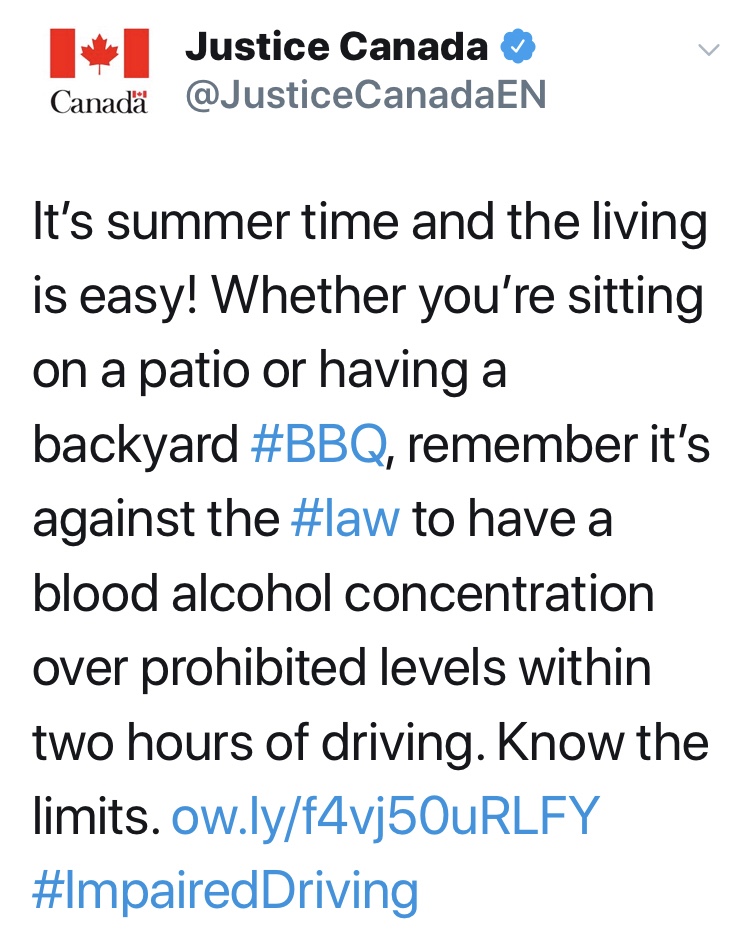


The law that destroyed the Ontario Liberals was a proposed law. This one now is law.

Lawyers like me have been warning, for months, that this change is wildly unconstitutional. It’s legislative overreach. And it’s a political suicide note, too.

But it’s the law of the land. It gives police the power to demand you submit to a breathalyzer, even they don’t have a reasonable suspicion you’re impaired. Even if you aren’t behind the wheel.

When this change was being considered, legal experts warned that a Canadian who drives home, sober, and then consumes some alcohol could register a fail on the breathalyzer – even though they didn’t drive while drunk. And that’s in fact what happened to a B.C. woman: she was by the pool at her sister’s place, having a drink, when the RCMP arrived and demanded a breath sample.

She lost her licence and her vehicle. Ultimately, she defeated the impairment charge on a technicality – but not before spending thousands on legal fees.

The media are already calling this a “police state” law. That it’s “an inexcusable violation of an individual’s Charter rights, and an invitation to police harassment of visible minorities“. Hell, even the CBC is calling it “unnecessary police power.”

Make no mistake: this issue – coming in the Summer before an election – is potentially lethal for Justin Trudeau’s Liberals. Andrew Scheer’s Conservatives, I am told, are now preparing to do to Trudeau what Mike Harris and a Toronto Sun headline did to Lyn McLeod.

Have a drink, wind up in the clink”: may not be as deadly as that long-ago Sun headline. But it may do the trick.

UPDATE: Oh, look. Shortly after the above post went up, something interesting happened. I’d say they are nervous, wouldn’t you?


My latest: amend the constitution, save the planet

Want to save the planet? Amend the Constitution.

In the United States, such an amendment has been sought since 1996.   Here’s what it says: “The natural resources of the nation are the heritage of present and future generations.  The right of each person to clean and healthful air and water, and to the protection of the other natural resources of the nation, shall not be abridged by any person.”

That sort of statement exists in the state constitutions in Hawaii, Illinois, Pennsylvania, Massachusetts and Montana.  But it hasn’t happened yet at the U.S. federal level.

Same in Canada.  In our constitutional rights document, the Charter of Rights and Freedoms, there are all manner of protections.  Section two says that all Canadians have the fundamental freedoms of conscience, religion, thought, belief, opinion, expression and “freedom of the press and other media of communication.”  It also declares that peaceable assembly and association are fundamental freedoms.

Sections three, four and five proclaim and protect democratic rights.  Six gives us mobility rights within Canada, and the right to a livelihood.  Section seven asserts our right to “life, liberty and security of the person.”  Eight protects us from unreasonable searches and seizures; nine protects us against arbitrary detention or imprisonment.  Ten to 14 describe our rights when we are arrested or facing trial.

And section 15, importantly, constitutionalizes the notion that Canadians have “the right to the equal protection and equal benefit of the law without discrimination” – meaning no discrimination based on race, national or ethnic origin, colour, religion, sex, age or mental or physical disability.  There are quite a few sections about language rights after that.  Section 25: aboriginal rights.  Section 27: multiculturalism.  Section 28: gender equality.

But nothing – nothing – about the environment.  When you consider, say, that mobility rights don’t matter so much when your part of Canada is on fire, or under water, that’s a critical lapse.  When there’s no air left to breathe, equality rights tend to take a back seat.

It can be argued, and has been, that section seven’s “life, liberty and security of the person” includes the environment.  In about 20 countries around the world, in fact, constitutional court challenges are presently taking place, in which plaintiffs are arguing that life, liberty and personal security are being infringed by inadequate, or non-existent, environmental protections.  

Last November in Quebec, a group called Environnment Jeunesse started a class action in Quebec Superior Court, seeking $340 million in damages – $100 per young person in the class.  The young Quebecois are arguing that the section seven rights of young Canadians were being violated because the federal government hasn’t done enough about climate change. 

Because, you know, it hasn’t.  

The Justin Trudeau government talks a good environmental game, of course.  With much fanfare, it recently insisted that it will ban single-use plastics.  And then, just a few days later, Trudeau is photographed by his own office – In Quebec! At a lunch with a group of young people, the aforementioned plaintiffs! – sitting at a conference table where plastic cutlery was in plain view.

The Conservatives have an environmental plan, too, but it has been attacked by its former leader, Kim Campbell.  The New Democrats have tabled something called “Power to Change: A new deal for climate action and good jobs.”  It says it’ll meet its targets before other parties say they’ll meet theirs.  But everyone knows the federal NDP will be unlikely to form government anytime soon.

The Green Party, as its very name suggests, is arguably the most serious about avoiding environmental calamity.  That is partly why Elizabeth May’s party has rocketed ahead of the NDP to take third place in recent polls – and why liberals and Liberals (like this writer) have donated to them, and plan to vote and work for them.

The Green Party’s environmental plan is the one that deserves the greatest scrutiny, because – if, as recent polls also suggest, a minority government is almost inevitable – it is the one now most likely to be implemented.  Elizabeth May will be the most powerful person in Canada, in effect, because she will hold the balance of power in late 2019 and beyond.

May’s plan calls for modernizing the national electricity grid; creating trades jobs by retrofitting every building in Canada; ending all imports of foreign oil, and using only Canadian fossil fuels; and pushing adaptation measures to protect agriculture, fishing and forestry from climate change.  It’s not bad.

To achieve it, or part of it, more than a minority Parliament is needed.  We also need a national consensus, one that can’t be diluted by lobbyists, self-interest, and the vagaries of election results.  If recent events have shown us anything, it is that there is a paradox at the epicentre of Canadian politics: we all care about the environment, but we all lack the means or the will to do something meaningful about it.

The Constitution, as Environnment Jeunesse has already figured out, is the way to address that.  If we are serious about saving our part of the planet – and polls suggests that an overwhelming majority of Canadians, from cost to rising coast, are – then let’s constitutionalize our collective desire.

Every other right and freedom is protected in there.  Why not the right to an environment, too?


My latest: hypocrisy, thine name is JT

“A hypocrite,” Adlai Stevenson said, “is the kind of politician who would cut down a redwood tree, then mount the stump and make a speech for conservation.”

That’s all that the first Adlai Stevenson left behind in the sands of time, pretty much. He was the 23rd vice-president of the United States, he was from Illinois, and he was a Democrat. His grandson was the Democratic Party’s candidate for president a couple of times, in the 50s. But old Uncle Adlai, as he was called? He was just remembered for his aphorisms, pretty much.

That one above, the one about political hypocrisy, should be printed out, laminated, and pinned to Justin Trudeau’s shirt (You know, like parents do with kids who might wander away during field trips to the zoo).

Trudeau’s PMO staff, too, should have Adlai Stevenson’s pithy maxim tattooed to their foreheads, so that they remember the cardinal rule when they are at their next “deliverology” meeting: In politics, you can get away with all manner of misdeeds and sins. But hypocrisy? Political hypocrisy is lethal. It is toxic. It is the scarlet letter.

To wit: Justin Trudeau and his PMO are hypocrites. There is no shortage of evidence.

This week, for example, Prime Minister Selfie tweeted out a nice photo of himself with something called the “Papineau Youth Council,” whatever that is.  Fresh-faced youngsters ringed a table listening to Trudeau talk about, as he put it, ways “to fight climate change.”  That’s a quote.

Eyeballing the taxpayer-subsidized snapshot, we see:

• Pizza (not weird, it’s a political backroom staple)

• Trudeau’s pizza slices, both flipped over (super weird)

• None of the kids smiling, not even a bit (also weird, but who can blame them, really)

• Right in the foreground, a pile of plastic cutlery (weird AND wildly hypocritical)

Plastic cutlery?  That’s weird – because, really, who uses cutlery to eat pizza?

And it’s hypocritical, too, because this is the selfsame Prime Minister, boys and girls, who just a few days ago said he planned to ban so-called single-use plastics. Like, um, plastic cutlery. He also said his family uses “like, drink box water bottles sort of things,” and none of us know what that means. Still.

Political graveyards are littered with the remains of political hypocrites. Pat Buchanan, for example. As I write in my must-have book, The War Room, when he was making one of his many quixotic runs at the presidency, Buchanan started promoting the Trumpist “America First” tagline everywhere. Hire only Americans, buy only American. 

So the advisors to George H. W. Bush discovered a key factoid about Buchanan’s “America First” private life: he personally drove a Mercedes, made in far-away Germany. They passed along that little revelation out to the media hordes, and that was the end of Pat.

Another example:  Democrat Gary Hart.  Back in 1987, when the family-friendly Senator was making his second run at the top job, rumours were rampant he was following his little soldier into battle a bit too frequently. Gary was indignant about this scurrilous assault on his personal life. Said he: “Follow me around.  I don’t care.  They’ll be bored.”

The media followed him around. They weren’t bored.  Gary – thereafter photographed with model Donna Rice balanced on his senatorial knee, on a yacht called (we kid you not) Monkey Business – ended up caring, quite a bit.  And that was the end of Gary.

Have Justin Trudeau’s well-documented hypocrisies similarly doomed him to defeat in October? The polls suggest the best the Liberal leader can hope for is a minority government. If that.

So, if Trudeau loses, LavScam, unbalanced budgets, the Aga Khan and decidedly unharmonious fed-prov relations will figure prominently as causes.

 But one politically-fatal word, above all the others, will be seen on Justin Trudeau’s headstone:

 HYPOCRITE.


My latest: dogs and politicos

Why do political people love dogs?

Because we do, we do. Proof is at hand.

MacKenzie King’s personal legacy – characterized, as it was, by his avid spiritualism, his byzantine diaries, and his nighttime strolls down certain streets the Market – is not without controversy. A debate rages, even now, about whether Canada’s longest-serving Prime Minister was a political genius or a certifiable nut job.

But about one part of King’s private life there can be no dispute: his love of his three Irish Terriers, all of whom he named Pat.

Pat, Pat and Pat. (Among other things, it reduces monogramming costs.)

Alliteratively, King called the Irish Terriers “red, racy and rectangular,” and they sort of were. King, being a man who was always distant from his fellow man (and woman, except for those ones he ran into in the Market at night), was closest to Pat. The dog went everywhere with him. He trusted it more than he trusted any human, save and except his beloved mother. (Who, along with the departed Pats, he attempted to commune with in seances.)

Here is what he write in his diaries about the Pats. It is something that any politico could write about their dog, too.

“[Pat is] a God-sent little angel in the guise of a dog, my dear little saviour,” King wrote. “[He is perfect because he] asks only to be near your and to share in a companionship of pure trust.”

And that is why every political dog is beloved by their political human: trust. They listen, they do not talk back, and they keep secrets secret.

After taking office in 1957, Dief the Chief ordered his staff to come up with a name for the dog he was given by a fan. He wanted to call it “Tory,” but his staff were worried that the pup would become fodder for editorial cartoonists. So he was named Happy instead.

Like King, whom he deeply despised, Dief was singularly unimaginative about dog names. Thus, there was more than one Diefenbaker dog named Happy. Happy the Second was not a terrier, but he was a terror, often disappearing from the Conservative leader’s office. Dief’s driver would then be dispatched to find Happy II, and he always did. “My dog has the ancestry and the distinguished pedigree, but no training at all,” said Canada’s thirteenth Prime Minister, who could have been also describing Canada’s twenty-third Prime Minister.

Stephen Harper was a big fan of cats, by the way, which tells you all that you need to know. He also had a chinchilla named Charlie, which is partially redeeming, but not entirely.

Did Pierre Trudeau like dogs? Did he have one? Was he almost certainly a cat person, like that Harper fellow? History does not record the truth. His son Justin, however, has a Portuguese water dog, who is neither Portgguese nor made of water. His name is Kenzie.

When he arrived at the Prime Ministerial homestead in 2016, that hard-ass hard-news outlet, The Huffington Post, headlined the resulting story: “Justin Trudeau Dog: The Prime Minister’s Family Got Even Cuter! Meet the prime minister’s newest family member!”

In a tough and unforgiving report, the HuffPo wrote: “Last week, Prime Minister Justin Trudeau broke some very big news for his family: they got a puppy! Along with an adorable photo of two-year-old Hadrien playing with the new dog, Trudeau tweeted: “#tbt to the little one meeting our newest arrival a few months ago. Say hello to Kenzie.”

Kenzie, we note, hasn’t been much seen in public since 2016. In this way, he is like electoral reform, a balanced budget, federal-provincial harmony, and reconciliation with indigenous peoples.

Why all this talk about politicos and dogs, you ask? Simple: one of mine – the beautiful, sweet and perfect Daisy, after whom I named my company – slipped away last week. I have been shattered ever since. I miss that dog, a lot.

Why do we political types love them so? Because, as King, and Dief, and others knew too well, politics is a business you do not enter to make friends. It is nasty, brutish and usually shorter than expected.

But at the end of a long day of treachery and back-stabbing, nothing repairs the political heart better than those brown eyes, and that wet nose, asking for nothing but love.

Rest easy, Daisy. Meet your new friends, Pat and Happy and all the others.

You all have secrets to share.


My latest in the Sun: when they came for the Jews/Sikhs/Muslims, they said nothing

Silence.

That’s all that could be heard from the federal party leaders, essentially: silence, or something approaching that.

The occasion: the decision of assorted Quebec politicians to pass a law telling religious people what they can wear. Jews, Sikhs, but mainly Muslims.

The law, formerly called Bill 21, was passed last weekend in a special sitting of the so-called National Assembly. It makes it illegal to wear religious symbols at work if you’re a teacher, a bus driver, a cop, a nurse, or even a day care worker. It applies to everyone who gets a stipend from the province, basically.

The law is illegal. It is wildly unconstitutional, for all the reasons you’d expect: it stomps all over freedom of speech, freedom of religion and equality rights. It giddily shreds the Charter of Rights and Freedoms.

The law is against the law. So, Quebec’s ruling class – who have never been particularly fussy about Jews, Sikhs or Muslims, truth be told – also stipulated that their law would operate “notwithstanding” the Charter.

In Quebec, now, you’ve theoretically got freedom of speech and religion. Except, say, when the chauvinists in the National Assembly say you don’t.

Stick that yarmulke in your pocket, Jew. Remove that turban your faith requires you to wear, Sikh. Put it away.

As history has shown us, freedoms rarely get swept away with dramatic decrees. Instead, we lose freedoms by degrees. In bits and pieces. Fascism typically slips into our lives without a sound, like a snake slithering into the kitchen, unseen.

This week, the snake curled around the ankles of Justin Trudeau, Andrew Scheer and Jagmeet Singh. All of them pretended that the snake was not there.

Justin Trudeau, in his teeny-tiniest mouse voice, suggested that no one should “tell a woman what she can and cannot wear.” That’s all we got from him, pretty much.

Andrew Scheer, for his part, said he “would never present a bill like that at the federal level.” But, he hastily added, he would also leave the whole messy business to the “elected members in Quebec.”

Jagmeet Singh, who now couldn’t get a provincial job in Quebec because he wears a turban himself, said this about the law when it was tabled: “I think it’s hurtful, because I remember what it’s like to grow up and not feel like I belong.”

Words.

But action? Actually, you know, doing something to protect minority rights and religious freedoms in Quebec?

Not on your life. It’s an election year, pal.

During one of the many, many debates Quebec has had about this legislated intolerance – when controversy was raging about the then-Liberal government’s bill that would force women to remove veils when, say, getting on a city bus – Francois Legault, then an Opposition leader, was asked about the crucifix hanging in the National Assembly.

It should stay, he said. “We have a Christian heritage in Quebec,” he said. “I don’t see any problem keeping it.”

That’s when Francois Legault’s veil slipped, as it were. That’s when we got to see who he really represents.

At his very first press conference after the Quebec election, Legault dispensed with any notion that he would be the Premier to all. To the Muslims (with their headscarves), and the Jews (with their kippahs), and the Hindus (with their markings on their faces), Legault’s message was plain: I don’t represent you. I don’t care about you. You are lower-class.

And, now, from our federal leaders: a shrug. Indifference.

Jesus, from that spot He long had above the National Assembly, is (as always) needed. Right about now, Jesus could remind our politicians, federal and provincial, what he said in Matthew 23:3. You know:

“Do not do what they do, for they do not practice what they preach.”


Our Daisy

Daisy.

Daisy is my company, but – for almost as long – Daisy was a dog, too.

I got her in 2007, at a place out of town. She rode in a cardboard box beside me, on the front seat, and she was perfect. A perfect chocolate lab. Her disposition was a ten, the breeder told me.

I don’t know how they measure those things, but it turned out that Daisy was indeed a ten. We were all so sad from the loss of our long-time border collie, Sheena. But Daisy made us feel better. She gave us joy, basically. That was her job.

And she proceeded to do so for the next almost-13-years, too. Through health challenges, through pain, through a marriage breakup. Through all of that and more.

She loved jumping in our lake, chasing whatever we’d throw in there: she’d leap as far as she could, retrieve the stick, and then swim back. She’d do that a 100 times, if you let her.

She loved being up there in the woods, too. As we would round the bend, heading towards the dock, she’d make these little sounds, and we knew what they were: Daisy expressing her own joy.

She loved her family, her four kids, and – most of all – her mother, Suzanne. She loved walks. She loved her expensive dog food. She loved us.

And, we loved her.

You wonder if you should mourn a dog so deeply, but you do. We do. I do. They make their way into your hearts, into your lives, into every family memory. And, even though they aren’t here as long as their humans are, they are indisputably part of the family.

Our family, the Kinsella-Amos family, are down a member, tonight. We will miss her and love her – and we will forever see her in our memory, leaping into Lake Weslemkoon to get that stick.

Bye, Daisy. You were the best dog. We love you.

Now, go get that stick.


Five free comms tips for Justin Trudeau

The Gettysburg Address it was not.

Standing on the picturesque shores of some picturesque lake in Mont-Saint-Hillaire, Quebec, Justin Trudeau was asked what he and his family had done to cut single-use plastics out of their lives.

Here is what he said, verbatim.

“We…uh…uh…we have recently switched to drinking water bottles out of…water out of when we have, uh, bottles out of, uh, plastic, sorry, away from plastic towards, uh, paper.  Like, drink box water bottles sort of things.”

The Liberal Prime Minister’s was so proudly unintelligible, so defiantly incomprehensible, it instantly went viral, supplying fodder for dozens of anti-Trudeau memes across the Internet for the next 100 years.  It was mocked and maligned from coast to coast to coast, including by people who actually still sort of like Justin Trudeau.  Heck, the clever Sodastream beverage people even put together an ad about it, with the tagline: “Justin, just say Sodastream.” Trolled by a big international company: ouch.

It reminded all and sundry that Gerald Butts has indeed left the building, and that Justin Trudeau has started to sound like Tom Hanks in Forrest Gump, except way worse.  Or Zoolander, even, but on a bad day.

How did the oxymoronic brain trust in Trudeau’s PMO not see that coming?  How did they not supply the Actor-In-Chief with an answer to one of the three most enduring political questions, namely: “Do you practice what you preach? (The other two being: “What did you know and when did you know it?” and “Why did you party on that boat with a bunch of topless co-eds?”)

Since it is becoming evident that Chief of Staff Katie Telford and Liberal campaign manager Jeremy Broadhurst couldn’t communicate their way out of a moist, environmentally-friendly paper bag, it is incumbent upon the rest of us to provide Prime Minister Chewbacca Socks with some communications guidance.

Herewith and hereupon, the Hill Times’ Five Immutable Comms Rules, gratis.

  1. Don’t mangle the message, man.  Last week, in the wake of the important report by the National Inquiry into Missing and Murdered Indigenous Women and Girls, Justin Trudeau declined to say “genocide” had taken place.  A few hours later, he flip-flopped and said genocide had taken place.  Then, a couple days later, he changed his mind again, and said it wasn’t genocide, but “cultural genocide.”  In the process, Trudeau sounded like the aforementioned Messrs. Gump and Zoolander.  As such, it was essential that Trudeau’s Great Big Announcement about single-use plastics be clear, consistent and coherent.  It wasn’t.
  2. Don’t sell snow shovels in June.  Or, in this case, don’t make a Great Big Announcement – and we know it was a Great Big Announcement because your office had been telegraphing that for days – when the biggest sporting event in Canadian history was also taking place.  You know: that little match-up between the Toronto Raptors and the Golden State Warriors.  It was in all the papers, Katie and Jeremy: it was kind of a big deal, in the immortal words of Ron Burgundy.  Pro tip, Justin: if you are proposing something to fundamentally change the way millions of Canadians will live their lives, don’t do it when Canadians are paying attention to someone who has fundamentally changed the way millions of Canadians now live their lives, cf. Kawhi Leonard.  Just don’t.
  3. Don’t wait too late.  In slightly more than 100 days, the writs will drop for the 2019 Canadian federal general election.  Why, why, why did the Trudeau Party wait untilnow to make their plastics announcement – when the European Union, among others, had done likewise long ago?  Announcing something this big, this late, convinces the few folks paying attention (see point two, above) that it was a cynical, desperate move to halt the undeniable momentum of the much-admired Liz May.  Because it was.
  4. Don’t forget to make it relevant. The banning of plastic straws became an early and frequent target of Trudeau’s announcement.  Parents of autistic kids, for example, reminded Trudeau that their kids needed such straws to, you know, consume liquids.  Why, then, didn’t Trudeau focus on the number one source of single-use plastic pollution.  Namely, cigarette butts.  They’re unsightly, they’re ugly, and they’re universally disliked.  They’re made out of cellulose acetate, which is plastic.  But Trudeau’s press release didn’t even mention them.  Dumb.
  5. Don’t be a hypocrite.  Mere moments after Trudeau said what he tried to say, the Internet was flooded with recent photos of the Prime Minister swilling water from plastic bottles – and it was reported that Trudeau’s family had spent $300 in a single month on water in plastic bottles.  Hypocrisy, thy name is Justin.

Anyway.  Will Justin Trudeau listen to all that excellent free advice?  Not on your life.

Because, these days, there’s no one who personifies the phrase “single-use plastic” better than the guy who, you know, made the announcement.


My latest: Trudeau’s enemy

Justin Trudeau needs an enemy.

In politics, you always do. Someone you can demonize. Someone you can warn voters about. Someone who suggests to voters that, while you may be imperfect, your enemy is far, far worse.

In politics, having the right enemy is more important than having the right friends. For voters, the devil one knows is always preferable to the devil one doesn’t.

For months, then, Justin Trudeau has been casting about for an enemy. He knows he is deeply unpopular – a Forum Research poll released this week found that 56 disapprove of his performance, with only 34 per cent approving – so he needs to act quickly. The election is just over 100 days away, give or take.

The Liberal leader’s task: find someone who is less popular than him. But who?

For a while, Trudeau attempted to convince Canadians that Andrew Scheer was a cross-burning, mouth-breathing, knuckle-dragging, red-necked lunatic. He’ll ban abortion, gay marriage and hold midnight rallies at 24 Sussex with Faith Goldy, Trudeau insinuated.

Except: Scheer said he won’t do any of those things, and polls indicate Canadians tend to believe him. Hell, Trudeau’s own Liberal caucus doesn’t even believe it – selfsame Liberal caucus having voted to instal Scheer in the Speaker’s chair, a few years back.

In his commercials, Scheer celebrates his blandness, his ordinariness. As he lopes around the hockey rinks of the nation, Timmie’s in hand, Scheer repeats his mantra: “I’m Blandy Andy, and I’m boring. You can count on me to do nothing radical. Go back to sleep.”

As Bill Davis memorably observed, eons ago: bland works. It’s working for Andrew Scheer.

So, who now to demonize, Prime Minister Chewbacca Socks? NDP leader Jagmeet Singh? That’s a waste of firepower. Singh, likeable as he is, is going nowhere fast.

Same with the People Party’s Gauleiter, Maxime Bernier. Trudeau doesn’t want to demonize Bernier – he wants him to do better, and chip away at Scheer’s lead in the polls. But Bernier has gone full alt-Right, and thereby consigned himself to the margins of Canadian politics, and the dustbin of history.

The Green Party’s Elizabeth May, meanwhile, is a worthier target: the aforementioned Forum Research poll has determined that May is the most popular leader in Canadian politics, with voters approving of her by a factor of two to one.

Her party, meanwhile, has reached a truly historic benchmark: Forum found that the Green Party of Canada is now actually tied with the New Democrats, at 13 per cent apiece. Many expect the nascent Greens to eclipse the Dippers in coming weeks.

Trudeau hasn’t attacked May – yet. But he has been, ahem, liberally swiping her policies to halt her momentum. His single-use plastic announcement, which made the wetsuit-and-jetski-era Stockwell Day sound perfectly Churchillian, was a disaster. It became the stuff of memes – and future attack ads – instantly.

All of it was motivated solely by Trudeau’s desperation to staunch the loss of Liberal support to the Greens. It is unlikely to work, because May is simply seen as more credible on the environment than Trudeau.

So, who to attack? The answer is obvious: the Mango Mussolini. Donald Trump is deeply disliked by Canadians from East to West, old to young, Left to Right. There is nothing that unifies Canadians more than anti-Trump sentiment.

But Trudeau has spent three years cravenly sucking up to the Unpresident, with nothing to show for it. It’s too late to do a volte-face now.

So who is left to demonize? Who, truly, is Justin Trudeau’s worst enemy? Who should he blame before he blames anyone else?

It’s the guy you spot in the bathroom mirror every morning, Justin.

It’s you.