
Two essays on Trump, populism and fascism
These two essays landed in my mailbox on the same cold and dark Fall morning. Both are lengthy, but worth your time. They mirror my mood.
Former Prime Minister Harper’s is the more optimistic take. He acknowledges that Trump’s rise has been “disruptive and dysfunctional,” but he calls it all “benign and constructive,” which is absolutely ridiculous. He suggests we need to proffer policy which mollifies and manages populism. Personally, I think that is highly naïve. You don’t offer sugar cubes to a rampaging bull: you kill it. My book New Dark Ages, out in a few days, certainly takes that position.
Here’s a bit of Harper’s essay:
The manifestation of this unease is a series of new and unorthodox political movements in most of the democratic world. From Brexit to Donald Trump and the “populist” parties of Europe, their success has hit establishment institutions with successive surprises that are provoking reactions leading from confusion to alarm and to outrage.
…These trends represent real costs to real people. Why should we be surprised when, ignored by traditional conservatives and derided by traditional liberals, these citizens start seeking alternative political choices? If policy does not seem to be working out for the public, in a democracy, you are supposed to fix the policy, not denounce the public. But, if you listen to some leaders and much of the media, you would not know it.
Their response is wrong, frustrating and dangerous. Wrong, because most of today’s political upheaval has readily identifiable causes. Frustrating, because it stands in the way of credible, pragmatic solutions that do exist. Dangerous, because the current populist upheaval is actually benign and constructive compared with what will follow if it is not addressed.
He’s a traditional conservative, standing on a shrinking patch of political real estate, and he’s responding to the crisis like traditional conservatives do: by suggesting that the likes of Trump can somehow be accommodated and managed. If the past two years have shown us anything, they’ve shown us how profoundly wrong that view is.
Closer to reality, and closer to my view, is this deeply disturbing essay in The New York Review of Books by Christopher R. Browning. Unlike Harper, Browning does not suggest that Trump and his ilk can be appeased and assuaged. They can’t be.
His view, and mine, is that conservative populism – the polished twin brother of fascism – is fully upon us, destroying every democratic and societal norm we took for granted in the post-WW2 period. His essay is worth your time.
I’ll conclude with this passage from it, which is depressing on a depressing day, but is also no less true for that.
Today, President Trump seems intent on withdrawing the US from the entire post–World War II structure of interlocking diplomatic, military, and economic agreements and organizations that have preserved peace, stability, and prosperity since 1945. His preference for bilateral relations, conceived as zero-sum rivalries in which he is the dominant player and “wins,” overlaps with the ideological preference of Steve Bannon and the so-called alt-right for the unfettered self-assertion of autonomous, xenophobic nation-states—in short, the pre-1914 international system. That “international anarchy” produced World War I, the Bolshevik Revolution, the Great Depression, the fascist dictatorships, World War II, and the Holocaust, precisely the sort of disasters that the post–World War II international system has for seven decades remarkably avoided.
In threatening trade wars with allies and adversaries alike, Trump justifies increased tariffs on our allies on the specious pretext that countries like Canada are a threat to our national security. He combines his constant disparagement of our democratic allies with open admiration of authoritarians. His naive and narcissistic confidence in his own powers of personal diplomacy and his faith in a handshake with the likes of Vladimir Putin and Kim Jong-un recall the hapless Neville Chamberlain (a man in every other regard different from Trump). Fortunately the US is so embedded in the international order it created after 1945, and the Republican Party and its business supporters are sufficiently alarmed over the threat to free trade, that Trump has not yet completed his agenda of withdrawal, though he has made astounding progress in a very short time.
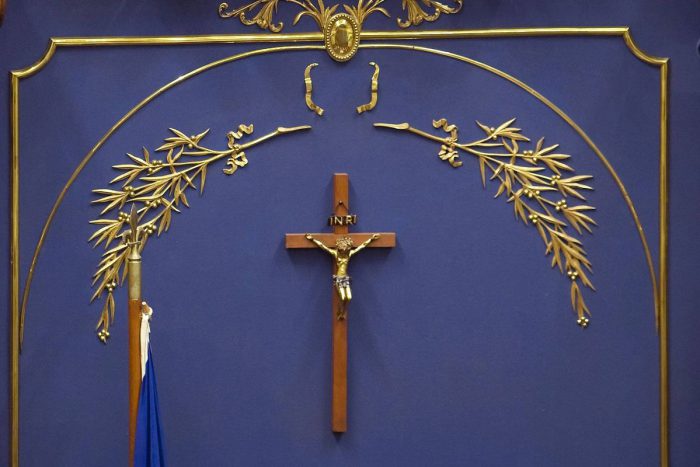 Pictured: law-breaking in Quebec.